
Whole Food vs. Supplements: How Your Body Absorbs Nutrients Differently
By Adalys E. Diaz, L.Ac.
Most people assume that if a nutrient exists in food, taking it as a supplement should work the same way. An orange has Vitamin C. A Vitamin C capsule has Vitamin C. Same thing, right?
Not quite — and understanding why may completely change how you think about your health.
The Difference Starts with How Your Body Receives the Nutrient
When you eat an orange your body does not just receive Vitamin C. It receives Vitamin C packaged inside a complete system — fiber, water, natural compounds, and cofactors — all working together to regulate exactly how much Vitamin C your body absorbs, how fast it enters your system, and where it goes.
When you take a Vitamin C capsule your body receives ascorbic acid alone — removed from everything that naturally surrounds it. The nutrients are the same. But without that complete system the absorption experience is completely different.
Scientists call this complete system the food matrix — the natural package in which nutrients exist inside whole food. Your body evolved over millions of years to interact with this matrix. It knows how to extract what it needs, absorb the right amount, and leave the rest behind.
Three Simple Examples:
The Carrot and Vitamin A
Your body converts beta-carotene from carrots into Vitamin A — but only as much as it actually needs. The food matrix regulates this automatically. High dose isolated Vitamin A supplements remove that built-in regulation entirely — and at high doses can actually become toxic. That has never happened from eating carrots.
The Orange and Vitamin C
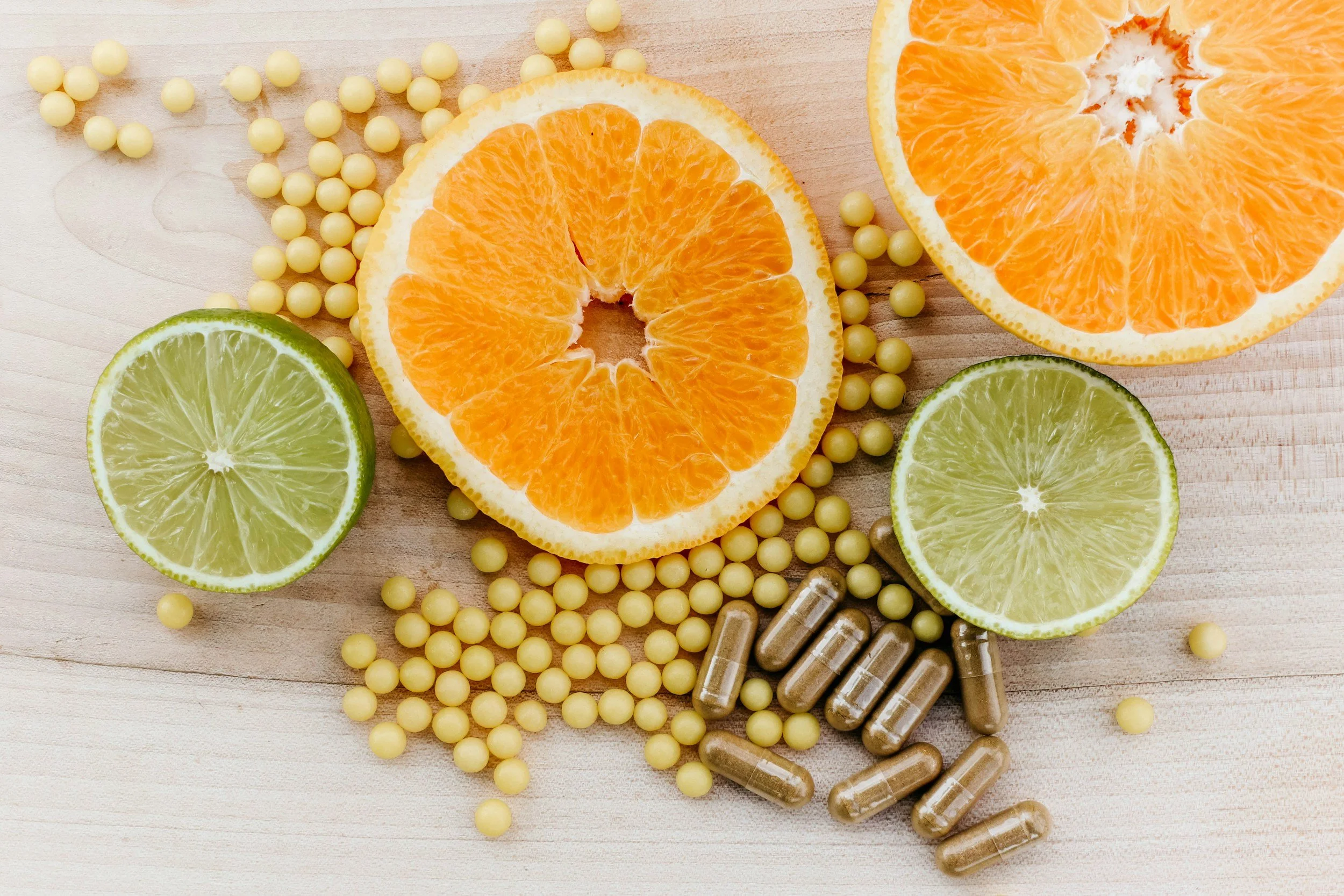
When you eat an orange your body receives Vitamin C alongside bioflavonoids, hesperidin, quercetin, fiber, and water — all helping it absorb more efficiently and work more effectively. A standard Vitamin C tablet delivers ascorbic acid alone. Same nutrient on the label. Very different experience in the body.
Whole Milk and Calcium
Calcium needs magnesium and Vitamin D to absorb properly into your bones. Whole milk naturally contains small amounts of both. A calcium supplement taken alone — without its natural partners — may absorb poorly and in some studies has been linked to calcium depositing in arteries rather than bones. The nutrient was delivered. But without the food matrix the result was not what anyone expected.
What Happens When Nutrients Leave the Food Matrix?
When a nutrient is isolated from its food matrix three important things change:
Absorption changes. Many nutrients need specific partners to absorb properly. These partners are naturally present in food but often missing in supplements. Without them absorption can be significantly reduced.
Nutrient balance is disrupted. Nutrients in food exist in carefully balanced relationships. When you take one nutrient alone at high doses you can shift these relationships — sometimes creating new imbalances your body did not have before.
The regulatory signal disappears. The food matrix tells your body how much of a nutrient to absorb. Without it this built-in regulation is lost — and your body loses the precision it has when absorbing from whole food.
Does This Mean Supplements Don't Work?
Absolutely not. Supplements are powerful and often essential — when used intelligently, in the right forms, at the right doses, for the right reasons.
There are situations where food simply cannot deliver what the body needs, these are some examples:
When deficiency is severe. A critically low ferritin level cannot be corrected by diet alone in any reasonable time. A precisely dosed, high quality iron supplement corrects it in weeks.
When absorption is impaired. Many people cannot efficiently absorb certain nutrients from food due to digestive conditions, genetic variants, age, or medication use.
When therapeutic doses are needed. Some conditions require nutrient levels impossible to achieve through food alone — therapeutic Omega-3 for triglycerides, high-dose Vitamin D to correct deficiency, or Magnesium to restore cellular levels.
When lifestyle creates gaps. Despite living in sunny South Florida, Vitamin D deficiency is remarkably common — because modern indoor life, sunscreen use, and individual metabolism mean sun exposure is often simply not enough.
In all these situations targeted supplementation is not just helpful — it is essential. The form of the supplement, the dose, and what it is combined with make an enormous difference in how much your body can actually absorb.
The Bottom Line
Now that you understand that your body absorbs nutrients from whole food and supplements differently — due to the food matrix — two things become very important.
First, knowing exactly what your body needs. Not guessing.
Second, combining supplements with the nutrients they need to absorb efficiently and work at their best.
This is what intelligent supplementation means. And it starts with understanding which supplements are truly complete — and which ones are missing the combinations your body needs to benefit the most.
That is exactly what I explore in Article 2.
Schedule Your Appointment: Call or Text (561) 895-1660
ABOUTAdalys E. Diaz, L.Ac.
Disclaimer: This information is for educational purposes only and is not intended to replace professional medical advice. Results may vary between individuals. Always consult with your healthcare provider about your specific condition.